
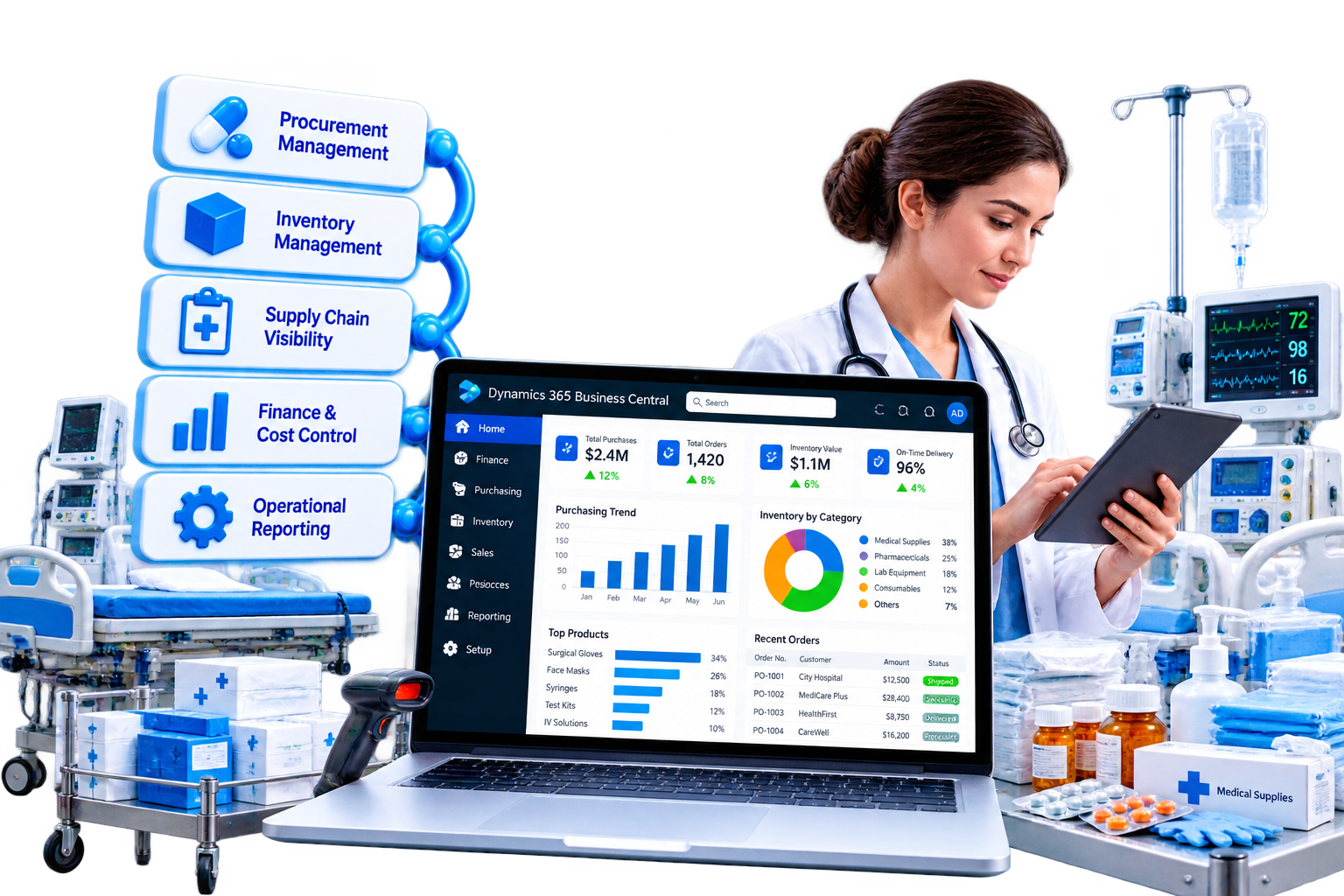

Business Central for Healthcare: Modernize Operations with Microsoft Dynamics 365

Healthcare organizations depend on reliable business systems to keep supplies available, manage purchasing, control costs and maintain accurate financial records. Disconnected systems can make it harder to coordinate administrative operations and understand spending across departments and locations. Sarakadiya helps healthcare organizations modernize, optimize and extend Microsoft Dynamics 365 Business Central to support finance, procurement, inventory and operational reporting. Whether you are migrating from Dynamics NAV, upgrading Business Central or integrating your ERP with other business applications, we help you define a practical modernization roadmap aligned with your organization’s needs.

Connect Healthcare Business Operations with Business Central

Microsoft Dynamics 365 Business Central is an ERP solution, not a clinical or electronic health record system. It supports the financial and operational processes that sit around healthcare delivery. Sarakadiya helps healthcare organizations use Business Central to manage finance, purchasing, inventory and reporting while assessing integration opportunities with the clinical, administrative and operational systems they already use.

Plan Budgets and Resources

Use financial budgets, purchasing information and operational data to support spending plans and supply requirements. Detailed clinical resource planning typically requires specialist applications.

Manage Procurement

Connect purchase orders, vendor records, approvals, receipts and supplier invoices with inventory and financial processes. Additional workflows may be needed for specialized procurement policies or supplier qualification.

Manage Medical Supplies and Inventory

Track medical supplies, consumables and equipment parts across configured locations. Business Central supports item tracking, including lot numbers and expiration dates where configured, but specialized medical-device or pharmaceutical traceability requirements must be assessed separately.

Manage Fixed Assets

Use Business Central fixed asset functionality to record asset acquisition costs, depreciation and disposal for eligible assets. Detailed equipment maintenance, calibration, clinical equipment scheduling and biomedical service records may require a dedicated asset-management system.

Support Billing and Receivables

Manage applicable customer invoicing, receivables and financial transactions for non-clinical services or other business activities. Patient billing, insurance claims, clinical coding and payer-specific workflows generally require specialist healthcare systems or integrations.

Manage Finance Across Departments

Bring general ledger, budgets, payables, receivables and cash-flow reporting together. Use dimensions and appropriate company structures to analyze financial activity across departments, locations and entities.

Analyze Operational and Financial Performance

Use Business Central data and Power BI to report on expenditure, purchasing, inventory consumption, budgets and financial performance. Clinical outcomes and patient-care metrics require data from appropriate clinical systems and should be governed separately.

Optimize Administrative Processes

Identify opportunities to improve configuration, extensions, integrations, reporting and workflow automation while respecting organizational policies and applicable data-handling requirements.

Healthcare ERP Modernization, Built Around Your Organization

Your ERP may contain years of financial history, supplier records, inventory data, integrations and customized business rules. Modernization does not automatically mean replacing everything. It means understanding what works, identifying technical and operational limitations, and defining a practical path toward a maintainable Business Central environment. Sarakadiya assesses your existing Dynamics NAV or Business Central setup to determine what should be retained, improved, replaced or integrated. For healthcare organizations, modernization planning should also consider data classification, access controls, privacy obligations, auditability, integration security and the requirements applicable to the organization’s location and activities.

Our Healthcare-Focused Business Central Services

Solve the Challenges Behind Healthcare Growth

Legacy ERP Limitations

Older Dynamics NAV environments or outdated Business Central configurations can make change difficult. We assess your current environment and define a practical modernization roadmap.

Complex Customizations

Custom finance workflows, inventory rules and reporting logic can become difficult to maintain. We help determine what to retain, simplify, replace or rebuild.

Disconnected Business Systems

Finance, procurement, inventory and administrative applications may operate separately. We assess integration opportunities to improve data exchange and reduce duplicate entry while preserving appropriate access controls.

Limited Spend and Supply Visibility

Healthcare leaders need a clearer view of expenditure, supplier costs and supply usage. We help structure ERP data and reporting to support better financial and operational decisions.

Manual Administrative Processes

Paper approvals, re-entered invoices and manual reconciliations can consume staff time. We identify opportunities to streamline workflows through configuration, integrations and automation.

Multi-Location and Multi-Entity Complexity

Additional clinics, facilities, departments and legal entities can increase reporting and governance demands. We help align Business Central configuration and reporting with the organization's structure and financial requirements.

Data Security and Integration Risks

Healthcare environments may involve sensitive information and strict data-handling requirements. We assess integration design and relevant technical controls as part of modernization planning; compliance must be evaluated against the organization's specific obligations and system landscape.

Business Central for Different Healthcare Organizations

Clinics and Medical Practices

Support financial management, purchasing, supplies and administrative reporting. Patient scheduling, clinical documentation, electronic health records and clinical billing generally require specialist healthcare applications.

Multi-Location Healthcare Providers

Use appropriate company, location, dimension and reporting configurations to support financial visibility across clinics and facilities. Consolidated reporting depends on the organization’s structure and the relevant Business Central setup.

Medical Supply and Device Companies

Manage purchasing, inventory, sales and finance, with item-tracking capabilities where configured. Regulatory device traceability, serial-number lifecycle requirements, quality records and specialized distribution controls may require additional systems or extensions.

Pharmacies and Pharmacy Groups

Support suitable purchasing, inventory and financial processes. Prescription dispensing, patient medication records, controlled-drug workflows, pharmacy claims and pharmacy-specific regulatory functions require dedicated pharmacy systems or integrations.

Healthcare Service Groups

Support financial reporting, purchasing, assets and operational expenditure across departments and entities. Specialized workforce scheduling, clinical operations and service-delivery management may require complementary applications.

Extend Business Central Across Your Healthcare Ecosystem

Business Central can serve as the ERP foundation for finance and business operations. Microsoft technologies, extensions and connected applications can support additional workflows where needed.

From Legacy ERP to a Modern Healthcare Platform

A Structured Approach to Business Central Modernization

Whether you are running Dynamics NAV, an older Business Central version or a system that needs performance improvements, Sarakadiya begins by assessing your existing environment, business processes and modernization priorities. We then recommend a practical path based on your ERP version, deployment model, customizations, extensions, integrations, data requirements and operational dependencies. For NAV environments, the migration route depends on the source version and Microsoft’s supported options. Legacy C/AL customizations may need conversion to AL extensions, while some functionality may be replaced with standard capabilities or reimplemented. The modernization plan should also consider data protection, access controls, integration security, auditability and the organization’s applicable regulatory requirements. The goal is to establish a maintainable ERP foundation that supports dependable financial and administrative operations without treating Business Central as a replacement for clinical systems.

Why Sarakadiya for Healthcare?

Business Central Specialists

We focus on Business Central migration, upgrades, application modernization, extensions and optimization to help healthcare organizations improve their ERP environment.

Legacy ERP Expertise

We assess Dynamics NAV and existing Business Central environments to identify technical dependencies and recommend an appropriate modernization approach.

Operations-Focused Solutions

We consider the relationship between finance, procurement, inventory, assets and reporting when planning ERP improvements for healthcare business operations.

Modernization and Integration Expertise

We help evaluate legacy code, integration requirements, workflow automation, reporting needs and performance concerns.

Microsoft Ecosystem Alignment

We assess how Power Platform, Power BI, applicable Copilot capabilities and other Microsoft technologies can complement Business Central.

Lifecycle Improvement

Modernization continues beyond migration or upgrade. We help identify ongoing improvement opportunities through health checks, technical reviews, integration assessments and performance optimization.

Care Keeps Evolving. Your Business Systems Should Keep Pace.

Planning a Dynamics NAV migration, a Business Central upgrade or a health check of your existing healthcare ERP environment? Sarakadiya can assess your current setup, identify improvement opportunities and define a practical roadmap toward a more connected and maintainable Business Central environment.

Customer Logos

Case Studies

Explore how organizations worldwide transformed operations, streamlined finance and accelerated growth with Sarakadiya's Microsoft expertise.

Microsoft Dynamics GP to Business Central Migration

Helping a Multi-Entity Manufacturing Company Modernize Its ERP with Microsoft Dynamics 365 Business Central

Business Central Cloud Migration for a Managed Service Provider (MSP)

Seamlessly Upgrading an MSP from Business Central 15 On-Premises to Business Central 25 Cloud

Microsoft Copilot for Business Central: Transforming Business Operations

How a Distribution Company Leveraged Microsoft Copilot to Improve Productivity, Decision-Making, and Operational Efficiency

Frequently Asked Questions

What is Microsoft Dynamics 365 Business Central for healthcare?
Microsoft Dynamics 365 Business Central is an ERP solution that supports financial management, purchasing, inventory, fixed assets and reporting for healthcare organizations. It is not a clinical system or an electronic health record platform.
Yes. Sarakadiya can assess your NAV version, deployment model, customizations, integrations and data to recommend a suitable migration or reimplementation approach. The available route depends on Microsoft’s supported options for your environment.
Yes. We can review your current version, extensions, customizations, integrations and operational requirements to plan an appropriate upgrade and testing process.
A health check can cover system configuration, finance and inventory processes, extensions, integrations, performance, data quality and technical risks. The final scope depends on your environment and business priorities.
Yes. Business Central can integrate with suitable external applications through APIs, connectors, extensions or custom development. The integration approach depends on the systems, required data flows, technical interfaces and applicable privacy and security requirements.
Business Central is not designed to replace an electronic health record, clinical practice-management or patient-care system. These functions should remain in appropriate specialist applications, with integrations assessed where business processes require data exchange.
Yes. Business Central data can be used in Power BI reports and dashboards for spending, procurement, inventory and financial performance. Any inclusion of sensitive clinical or patient-related data requires a separate assessment of purpose, permissions and applicable data-protection requirements.
Business Central supports item tracking, including lot numbers and expiration dates where configured. Organizations with specialized pharmaceutical, medical-device or regulatory traceability requirements should assess whether standard capabilities are sufficient or whether additional applications or extensions are needed.
The outcome depends on the customization and migration path. For supported migrations to Business Central Online, legacy C/AL customizations must be converted to AL extensions or appropriately reimplemented. Some functionality may be replaced by standard Business Central capabilities or suitable extensions.

Directions Paris EMEA 2026 Expo Banner

WE’RE ATTENDING DIRECTIONS EMEA 2026

Date: October 27–29, 2026

We’re excited to be part of Directions EMEA 2026 in Paris, connecting with Microsoft Dynamics 365 Business Central partners, technology leaders, and industry experts.

Dimple Mamtora

Dimple Mamtora

HR Manager

Strategic HR leader specializing in talent acquisition, HR operations, employee experience, and organizational culture. She focuses on building agile, inclusive, and performance-driven workplaces through effective people strategies and streamlined HR practices.
Nisha patel

Nisha Patel

Marketing Manager

Marketing professional specializing in B2B SaaS, ERP ecosystems, and revenue-focused growth, with expertise across demand generation, go-to-market strategy, pre-sales enablement, and customer engagement. She brings a strong ability to connect business strategy with customer needs, driving pipeline growth, solution positioning, strategic partnerships, and measurable business outcomes.

Khushboo Prasad

VP of Technical Operations

Solution Architect specializing in Microsoft Dynamics 365 Business Central and NAV, with expertise across ERP implementations, upgrades, integrations, and business process optimization. She brings strong functional and technical knowledge across Finance, Sales, Purchase, Manufacturing, EDI, Azure DevOps, and Power Platform.
Kishan Nandaniya

Kishan Nandaniya

VP of Strategic Partnerships & Alliances

Vice President of Sales and Solution Consultant specializing in Microsoft Dynamics 365, Power BI, Customer Engagement, and Azure. He helps businesses align technology investments with strategic goals and drive measurable digital transformation.

Mayank Jangid

Sr. Technical Manager

Senior Technical Manager specializing in Microsoft Dynamics NAV and Dynamics 365 Business Central, with expertise in application development, technical consulting, and ERP solutions.

Sagar Dangar

Chief Technical Officer

Solution Architect and CTO specializing in Microsoft Dynamics NAV, Dynamics 365 Business Central, and CRM. His expertise spans enterprise architecture, ERP implementations, integrations, upgrades, custom development, and digital transformation.

Umesh Bobade

Project Lead

Techno-functional ERP Consultant specializing in Microsoft Dynamics 365 Business Central, with expertise in end-to-end ERP implementations, solution mapping, customization, and AL development.

Neha Nanda

Sr. Technical Manager

Senior Technical Manager and Microsoft Dynamics 365 Business Central technical consultant, specializing in ERP development, customization, technical solutions, and application delivery.

Pravin Dangar

Managing Director

Business leader and technology specialist with expertise spanning Microsoft ERP implementations, digital transformation, global accounting, financial structuring, and mining-sector operations. He brings together technology, industry knowledge, and business strategy to create sustainable growth.