

Home / Food & Beverages
Food and beverage businesses operate under constant pressure to manage ingredient costs, production schedules, shelf life, product traceability and changing customer demand. Disconnected systems can make it difficult to coordinate production, maintain accurate inventory records and protect margins.
Sarakadiya helps food and beverage companies modernize, optimize and extend Microsoft Dynamics 365 Business Central to connect production, inventory, purchasing, sales and finance.
Whether you are migrating from Dynamics NAV, upgrading Business Central or integrating your ERP with manufacturing, quality, labeling or distribution systems, we help you define a practical modernization roadmap aligned with your business requirements.
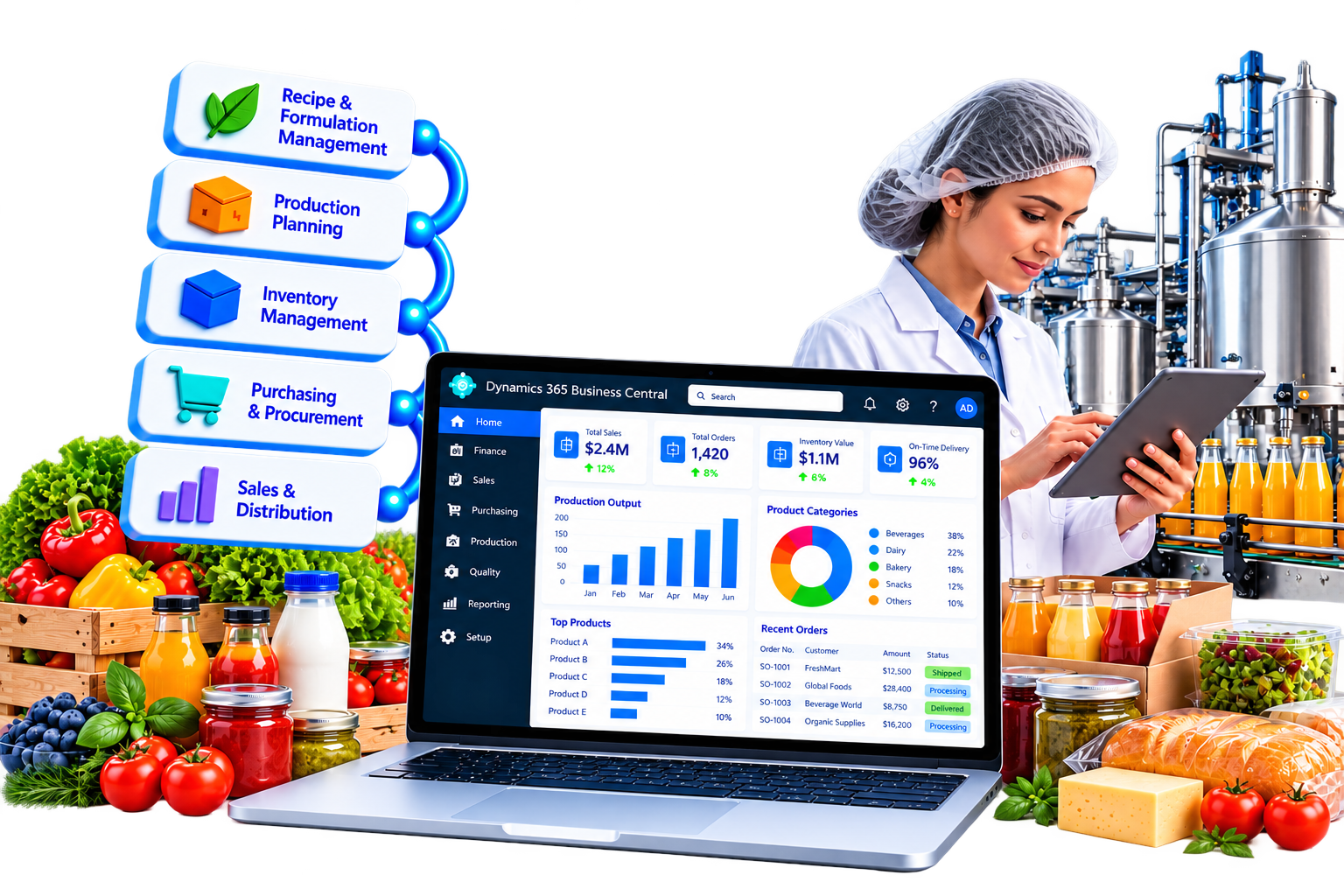
Food and beverage companies need visibility into ingredients, production output, batch records, expiration dates and product costs. Microsoft Dynamics 365 Business Central provides manufacturing, inventory, purchasing and financial management capabilities that can support these operations when configured appropriately.
Sarakadiya helps food and beverage businesses optimize Business Central to improve coordination across production planning, materials, inventory, order fulfillment and financial reporting.
Use demand, inventory and supply-planning information to help determine material requirements and production orders. Production scheduling depends on configured production BOMs, routings, work centers and capacity.
Manage supplier purchasing, receipts, inventory and invoice processing for raw materials, ingredients and packaging supplies. Supplier quality approval and specialized procurement controls may require additional workflows or applications.
Use production orders, production BOMs and routings to define components and manufacturing operations. These capabilities support production planning and costing but do not automatically provide every specialized recipe, formulation or process-manufacturing function.
Configure item tracking to record lot numbers and expiration dates for applicable ingredients and finished goods. Business Central also supports item tracing through recorded inventory transactions. End-to-end traceability depends on consistently capturing tracking information throughout receiving, production, storage and shipping.
Track materials and finished goods across configured locations and warehouses. Inventory can support cold-storage operations, but temperature monitoring, automated cold-chain alerts and environmental sensor data generally require connected systems.
Connect sales orders, inventory availability, shipments and invoicing. Configure suitable processes for product allocation and expiration-sensitive fulfillment; advanced warehouse execution may require additional capabilities.
Use production consumption, output and costing records alongside financial reporting to review material costs, production costs and profitability. Detailed yield, spoilage and waste analysis depends on how consumption, output, scrap and related costs are recorded.
Use Business Central data and Power BI to review production output, inventory, material costs and margins. Quality trends, waste rates and batch-level performance require appropriate source data and tailored reporting.
Your ERP may contain years of product records, ingredient specifications, production BOMs, supplier information, lot-tracking configurations, integrations and customized workflows. Modernization should start by understanding what your business relies on today.
Sarakadiya assesses your Dynamics NAV or Business Central environment to identify what can be retained, improved, replaced or integrated.
Our approach helps food and beverage companies plan for a more maintainable ERP environment while considering production continuity, data quality, traceability requirements and the operational impact of change.

Assess your NAV version, deployment model, customizations, data and integrations to identify a suitable migration or reimplementation path. Microsoft's supported options depend on your source environment and target platform.

Plan and execute version upgrades with appropriate reviews of extensions, customizations, integrations, data and business-process compatibility. The upgrade approach depends on the existing version and deployment model.

Review legacy customizations and identify opportunities to adopt standard functionality, simplify existing code or develop maintainable AL extensions. For NAV-to-Business Central Online migration paths, legacy C/AL customizations must be handled through conversion to AL extensions or appropriate reimplementation.

Review system configuration, production setup, item tracking, inventory, extensions, integrations, performance and technical risks. Where relevant, assess how production and traceability data flows across connected systems.

Investigate performance issues affecting production-order processing, inventory transactions, lot-tracking workflows, integrations and reporting. Recommendations may include configuration changes, extension reviews or technical remediation.

Assess integration options for quality management, labeling, barcode scanning, EDI, eCommerce, warehouse systems, shipping and production equipment. Integration scope depends on the applications, interfaces, data requirements and operational processes involved.

Identify repetitive activities such as approvals, document processing, data entry and reporting. Evaluate suitable Power Platform workflows and applicable Copilot capabilities based on licensing, product availability, data readiness and business requirements.

Older Dynamics NAV environments or outdated Business Central configurations can make enhancements difficult. We assess your existing environment and recommend a practical modernization roadmap.
Custom formulation logic, production calculations and costing workflows may become difficult to maintain. We help identify what standard production BOMs and routings can support and where specialized extensions or process-manufacturing solutions may be needed.
Reliable traceability depends on accurate lot assignment and recording across relevant transactions. We review item-tracking configuration and related workflows to help identify gaps in ingredient and finished-goods traceability.
Ingredient prices, production losses and changing output can affect profitability. We help improve the availability and reporting of consumption, output, scrap and costing data so management can make better-informed decisions.
Spreadsheets, paper records and duplicate data entry can slow production reporting and documentation. We assess opportunities to streamline workflows and connect Business Central with appropriate shop-floor, quality or document-management systems.
More products, facilities, suppliers and sales channels increase the demands on planning, inventory and reporting. We help align your ERP environment with evolving business processes and integration needs.
Use production orders, production BOMs, inventory and item tracking to manage materials and finished products. Detailed formulation management, nutritional calculations, allergen controls and packaging compliance may require specialized extensions or complementary systems.
Coordinate production materials, packaging components, inventory and fulfillment through suitable Business Central manufacturing and inventory processes. Beverage-specific requirements such as fermentation monitoring, tank management, blending and excise calculations may require additional solutions.
Manage purchasing, inventory, lot tracking, expiration dates, sales orders and financial transactions. Expiration-sensitive picking and advanced warehouse processes depend on configuration and the required warehouse capabilities.
Connect customer demand with production orders, material requirements and costing. The appropriate setup depends on whether products are made to order, produced for stock or handled through a combination of approaches.
Use production BOMs, routings, production orders and costing to support suitable manufacturing processes. Businesses requiring advanced formulation management, variable recipes, co-products, by-products, catch-weight handling or detailed process controls should assess extensions or specialist manufacturing solutions.
Business Central can provide the core ERP foundation for food and beverage operations. Microsoft technologies, extensions and third-party applications can extend that foundation where specialized production, quality or compliance capabilities are needed.

Use Power Apps and Power Automate for suitable approvals, data collection and workflow automation. Shop-floor data capture, inspection forms and production reporting may require custom apps, integrations or connected devices.

Build reports to analyze production output, material consumption, inventory, costs and margins. Waste, yield, quality and batch-performance indicators depend on the availability and consistency of the underlying data.

Evaluate applicable Copilot capabilities and other Microsoft AI options to support productivity, information access and selected workflows. Suitability depends on the specific product, licensing, availability, data quality and business requirements.

Use AL extensions to address requirements beyond standard functionality, such as specialized production calculations, additional validations or industry-specific workflows.

Integrate Business Central with appropriate quality-management, labeling, barcode, EDI, warehouse, shipping and production systems. Temperature monitoring, laboratory results, allergen management and specialized food-safety workflows may require dedicated applications or equipment integrations.

A Structured Approach to Business Central Modernization
Whether you are running Dynamics NAV, an older Business Central version or an ERP environment that needs performance improvements, Sarakadiya begins by assessing your current systems, business processes and modernization priorities.
We then recommend a practical path based on your ERP version, deployment model, customizations, extensions, data requirements and connected applications.

For NAV environments, the migration route depends on the source version and Microsoft’s supported options. Legacy C/AL customizations may need conversion to AL extensions, while some functionality may be replaced with standard capabilities or reimplemented.

The objective is to create a maintainable ERP foundation that supports production planning, inventory control, lot traceability and informed financial decisions as your business evolves.
We focus on Business Central migration, upgrades, application modernization, extensions and optimization to help companies improve their ERP environment.
We assess Dynamics NAV and existing Business Central environments to identify technical dependencies and recommend an appropriate modernization approach.
We consider how production orders, material consumption, inventory, item tracking and financial reporting work together when assessing your ERP requirements.
We help evaluate legacy code, connected manufacturing systems, automation opportunities, reporting needs and performance concerns.
We assess how Power Platform, Power BI, applicable Copilot capabilities and other Microsoft technologies can complement Business Central.
Modernization continues beyond migration or upgrade. We help identify ongoing improvement opportunities through health checks, technical reviews, integration assessments and performance optimization.
Planning a Dynamics NAV migration, a Business Central upgrade or a review of your current food and beverage ERP environment?
Sarakadiya can assess your existing setup, identify improvement opportunities and define a practical roadmap toward a more connected and maintainable Business Central environment.


Explore how organizations worldwide transformed operations, streamlined finance and accelerated growth with Sarakadiya's Microsoft expertise.
Seamlessly Upgrading an MSP from Business Central 15 On-Premises to Business Central 25 Cloud
Microsoft Dynamics 365 Business Central is an ERP solution that supports financial management, purchasing, inventory, sales and manufacturing. Food and beverage companies can use its production and item-tracking capabilities where appropriately configured, while specialized formulation, quality, compliance and cold-chain requirements may need additional solutions.
Yes. Sarakadiya can assess your NAV version, deployment model, customizations, integrations and data to recommend a suitable migration or reimplementation approach. The available route depends on Microsoft’s supported options for your environment.
Yes. We can review your current version, extensions, customizations, integrations and operational requirements to plan an appropriate upgrade and testing process.
A health check can cover system configuration, manufacturing setup, item tracking, inventory, extensions, integrations, performance, data quality and technical risks. The scope depends on your environment and business priorities.
Yes. Business Central supports item tracking using lot numbers and can record expiration dates when the relevant item-tracking configuration is enabled. Item tracing can help identify where tracked items were received, produced, sold or returned. Reliable traceability depends on consistently recording the required tracking information throughout the relevant processes.
Business Central provides core ERP, manufacturing and item-tracking capabilities, but it should not automatically be treated as a complete food safety or quality-management system. Requirements such as laboratory testing, quality inspection plans, allergen controls, regulatory documentation and automated temperature monitoring may require extensions or specialized applications.
Yes. Business Central can integrate with external applications through suitable APIs, connectors, extensions or custom development. The approach depends on the system, data requirements and available interfaces.
Business Central can record production consumption, output and scrap, which can support costing and analysis. Detailed yield calculations, waste categorization and production-efficiency reporting may require additional configuration, extensions or tailored Power BI reports.
The outcome depends on the customization and migration path. For supported migrations to Business Central Online, legacy C/AL customizations must be handled through AL extensions or an appropriate reimplementation approach. Some functionality may be replaced with standard Business Central capabilities or suitable extensions.
We’re excited to be part of Directions EMEA 2026 in Paris, connecting with Microsoft Dynamics 365 Business Central partners, technology leaders, and industry experts.