

Home / Fishing
Fishing and seafood businesses operate in a time-sensitive environment where perishable inventory, changing catch volumes, processing requirements and international buyers create complex operational demands.
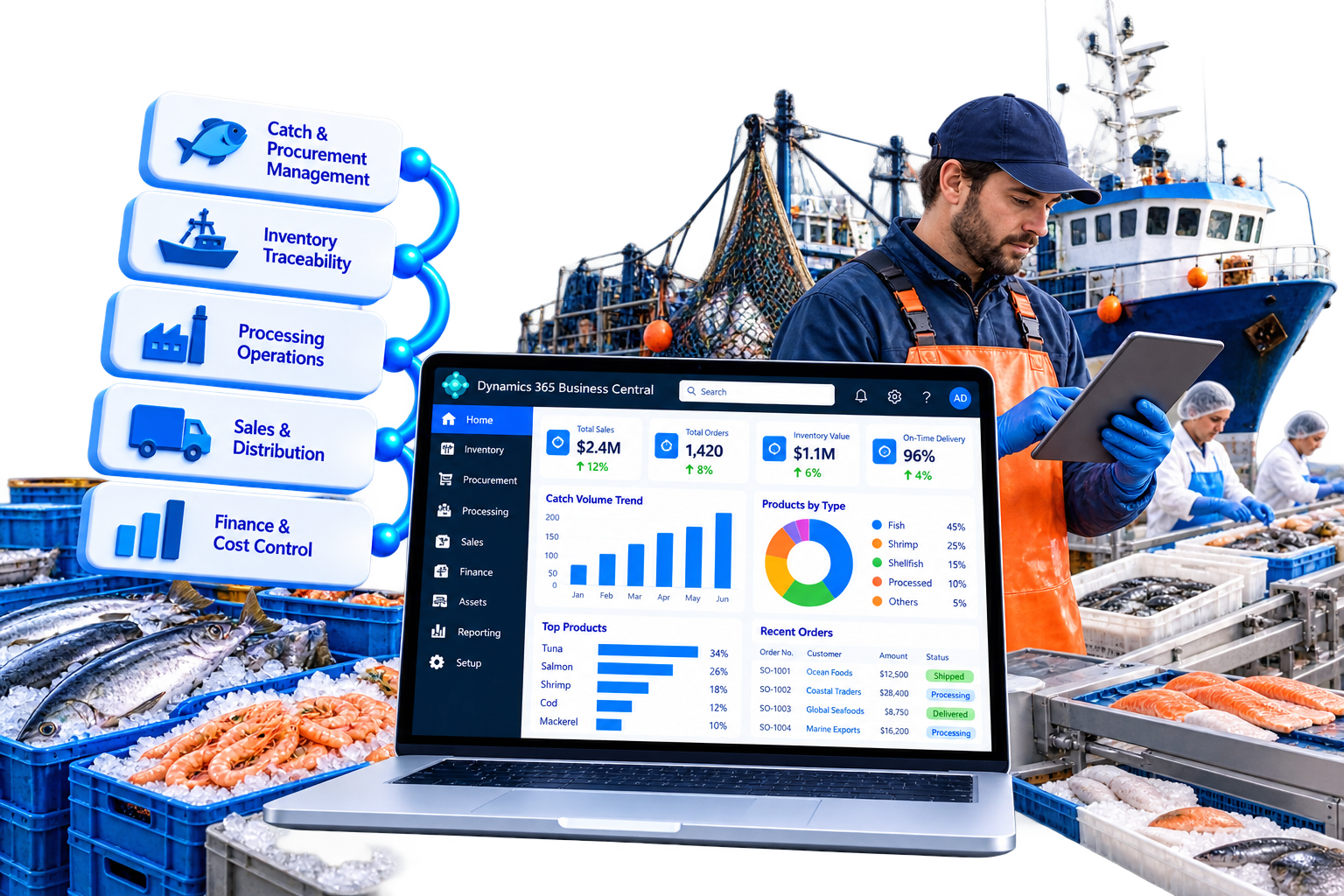
Sarakadiya helps fishing and seafood companies modernize, optimize and extend Microsoft Dynamics 365 Business Central to connect inventory, purchasing, processing-related operations, sales, assets and finance.
Whether you’re moving from Dynamics NAV, upgrading Business Central, modernizing legacy applications or connecting your ERP with operational systems, we help you define a practical path toward a more connected and scalable business environment.
Fishing and seafood businesses need visibility into what they receive, how products move through processing and storage, what they cost and where they are sold.
Microsoft Dynamics 365 Business Central provides capabilities for inventory management, lot tracking, purchasing, sales, production, fixed assets and multi-currency finance. With appropriate configuration and integrations, these capabilities can support key seafood business processes.
Sarakadiya helps fishing and seafood companies connect these capabilities to their operational requirements.
Align purchasing, inventory and sales planning with expected supply, demand and product availability.
Connect supplier purchasing, receipts, inventory and financial transactions to improve visibility into procurement costs.
Use Business Central's item tracking and item tracing capabilities to track lot-numbered items through recorded inventory transactions. End-to-end seafood traceability depends on appropriate lot assignment, processing records, transaction setup and integrations where required.
Support applicable processing and packing workflows through Business Central manufacturing functionality, production orders and item tracking, with extensions or specialist systems where seafood-specific requirements exceed standard capabilities.
Organize inventory across locations and warehouse processes. Temperature monitoring, shelf-life controls beyond configured item tracking and specialized cold-chain management may require additional solutions.
Connect sales orders, inventory, shipments and invoicing. Multi-currency transactions can support international sales, while specialized export documentation and regulatory requirements may require configuration or integration.
Maintain fixed asset records for eligible vessels, equipment and facilities, including acquisition costs and depreciation. Vessel operating costs and maintenance workflows may require additional configuration or specialist applications.
Use financial reporting, dimensions and appropriately configured cost allocation to analyze costs and margins across vessels, products, facilities or business units.
Connect Business Central data with Power BI to build reports for inventory, purchasing, sales, costs and other relevant operational measures. Yield and catch-performance reporting may require additional data capture and reporting models.
Your ERP holds years of supplier records, product data, financial transactions, customizations and integrations.
Modernization doesn’t necessarily mean starting over. It means understanding what works, identifying technical limitations and defining the right path toward a more maintainable Business Central environment.

Modernize legacy Microsoft Dynamics NAV environments through a migration or reimplementation approach based on your starting version, deployment model, customizations, data and business requirements.
Plan and execute appropriate Business Central upgrades while assessing application compatibility, extensions, customizations, integrations and data requirements.

Modernize legacy customizations and development approaches into maintainable Business Central extensions. For NAV environments moving to Business Central Online, legacy C/AL customizations need an appropriate modernization path, typically involving AL extensions or reimplementation of functionality.

Assess your environment across configuration, application architecture, extensions, customizations, integrations, performance and potential technical risks.

Investigate performance issues across application processes, posting, reporting, extensions and integrations, then prioritize appropriate improvements.

Connect Business Central with weighing systems, processing applications, quality-management systems, shipping platforms, export documentation tools and other operational systems where supported integration methods are available.

Identify opportunities to automate repetitive administrative processes and evaluate applicable Microsoft Power Platform, Copilot and AI capabilities.

Older Dynamics NAV environments and legacy Microsoft ERP systems can make upgrades, integrations and modernization increasingly complex. Sarakadiya helps assess your current environment and define a practical path toward Business Central modernization.
Custom costing, inventory workflows and operational integrations can become difficult to maintain over time. We help identify which customizations should be retained, modernized, replaced or retired.
Seafood businesses may need to connect supplier, catch, receiving, processing, storage and sales records to support customer and regulatory requirements. We assess how Business Central item tracking can support the required records and identify where additional data capture, extensions or specialist traceability systems may be needed.
Catch volumes, purchase prices, processing costs, waste and product yields can affect profitability. We help connect relevant ERP data with financial reporting and analytics to improve cost and margin visibility, subject to appropriate cost allocation and operational data capture.
Paper-based receiving, spreadsheets and disconnected systems can slow down inventory updates, approvals and reporting. We identify opportunities for integration, workflow automation and more consistent data capture.
New products, processing facilities, warehouses and export markets can add pressure to existing systems. We help evolve your Business Central environment to support changing business processes and operational requirements.
Connect eligible vessel and equipment fixed asset records with purchasing, inventory and finance. Catch recording, voyage costing and vessel operations may require specialized applications or extensions.
Connect purchasing, inventory, production-related processes, lot tracking and sales. Detailed yield calculations, grading, by-products and seafood-specific production workflows may require tailored extensions or specialist processing software.
Manage inventory, purchasing, sales orders, shipments and financial transactions across locations. Expiry-sensitive inventory and cold-chain monitoring require appropriate configuration or complementary solutions.
Manage international sales, multi-currency transactions, inventory and invoicing through Business Central. Export declarations, certificates, customs documentation and other market-specific requirements may require external systems or integrations.
Use Business Central for applicable purchasing, inventory, production-related processes, fixed assets and finance. Specialized requirements such as feeding schedules, water-quality monitoring, biomass tracking, mortality records and farm-cycle management generally require aquaculture-specific software or extensions.
Business Central can provide an ERP foundation for finance, inventory, purchasing, sales and other business processes. Sarakadiya helps identify where Microsoft technologies, extensions and integrations can connect that foundation with the wider seafood operation.

Use Power Apps and Power Automate to develop suitable business applications and workflows for tasks such as receiving, approvals and operational data entry, subject to the required design and integration.

Connect Business Central data with Power BI to report on inventory, purchasing, sales, financial performance and other operational KPIs. Yield, waste and catch-performance reports depend on collecting and modeling the relevant operational data.

Evaluate applicable Copilot and AI capabilities to support productivity and business processes. Availability and suitability depend on the specific capability, licensing, environment and integration requirements.
Use AL-based extensions to address requirements beyond standard functionality, including selected seafood-specific workflows where appropriate.

Integrate Business Central with weighing, quality, processing, shipping, export and other operational systems where the required APIs, connectors or integration methods are available.

Sarakadiya supports fishing and seafood businesses across the Business Central modernization lifecycle.
Whether you’re starting with Dynamics NAV, running an older Business Central version or looking to improve an existing environment, we assess your current setup and help identify the appropriate next step.
Every modernization journey is different. The recommended approach depends on your ERP version, deployment model, customizations, data requirements, integrations and operational priorities.
Sarakadiya helps fishing and seafood businesses get more value from their Microsoft Dynamics 365 Business Central environment through structured modernization, technical assessment and integration planning.
Focused services across Business Central migration, upgrades, application modernization, extensions and optimization.
A structured approach to assessing Dynamics NAV and other legacy Microsoft ERP environments.
Business Central capabilities aligned with purchasing, inventory, processing-related workflows, sales, assets and finance.
Support across application modernization, integrations, automation, analytics and performance optimization.
Extend Business Central through Microsoft technologies such as Power Platform, Power BI and applicable Copilot and AI capabilities.
Continue improving your ERP environment through ongoing assessment, optimization and modernization beyond migration or implementation.
The catch is only the beginning. Your systems need to support the journey from receiving and inventory through processing, sales and financial reporting.
Whether you’re planning a Dynamics NAV migration, a Business Central upgrade, application modernization or an ERP health check, Sarakadiya can help you assess your current environment and define a practical path forward.


Explore how organizations worldwide transformed operations, streamlined finance and accelerated growth with Sarakadiya's Microsoft expertise.
Seamlessly Upgrading an MSP from Business Central 15 On-Premises to Business Central 25 Cloud
Microsoft Dynamics 365 Business Central is an ERP platform that supports business processes such as purchasing, inventory, sales, finance, fixed assets and, in the Premium experience, manufacturing. Fishing and seafood businesses can use these capabilities as part of a wider operational system, with additional extensions or integrations where needed.
Yes. Sarakadiya can assess a legacy NAV environment and define an appropriate migration or reimplementation approach based on the existing version, deployment model, customizations, data and business requirements.
Yes. Sarakadiya can assess your current version, extensions, customizations, integrations and technical environment to help plan an appropriate upgrade and modernization approach.
A Business Central Health Check can evaluate configuration, extensions, customizations, integrations, performance and technical considerations to identify potential risks and opportunities for improvement.
Business Central supports lot-number tracking and item tracing across recorded inventory transactions. The extent of traceability depends on how lots are assigned and tracked through receiving, processing, transfers and sales. Seafood-specific traceability requirements may require additional fields, extensions or integrations.
Business Central supports locations, warehouse processes and configurable item tracking, including expiry-date tracking. Temperature monitoring, automated cold-chain alerts and specialized seafood shelf-life workflows may require additional applications or integrations.
Yes, Business Central can integrate with external systems through suitable APIs, connectors or custom integrations. The integration approach depends on the capabilities of the weighing, processing, shipping or export system and the data that needs to be exchanged.
Business Central provides financial dimensions, cost records and manufacturing-related costing capabilities that can contribute to cost analysis. However, detailed voyage costing, vessel-level operating costs, catch yield and processing yield require appropriate data capture, cost allocation, configuration, reporting or specialized extensions.
Aquaculture businesses can use Business Central for applicable purchasing, inventory, finance, assets and other supported business processes. Specialized aquaculture requirements such as biomass, feeding, water-quality monitoring and mortality tracking generally need dedicated software or extensions.
The approach depends on the customization and migration path. For Business Central Online, legacy C/AL customizations need an appropriate modernization path, typically conversion to AL extensions or reimplementation of the required functionality. Not every customization can be transferred unchanged.
We’re excited to be part of Directions EMEA 2026 in Paris, connecting with Microsoft Dynamics 365 Business Central partners, technology leaders, and industry experts.