

Home / Power Platform / Microsoft Fabric
Modernize your data architecture and turn fragmented business data into a connected foundation for analytics, business intelligence, and advanced data workloads.
At Sarakadiya, we provide Microsoft Fabric consulting and implementation services across OneLake, Data Factory, Lakehouse, Warehouse, Data Engineering, Data Science, Real-Time Intelligence, Power BI, semantic models, governance, integration, and Fabric modernization.
We help organizations connect data from ERP, CRM, databases, cloud applications, files, and other business systems and build a scalable Microsoft Fabric architecture aligned with their business and analytics requirements.
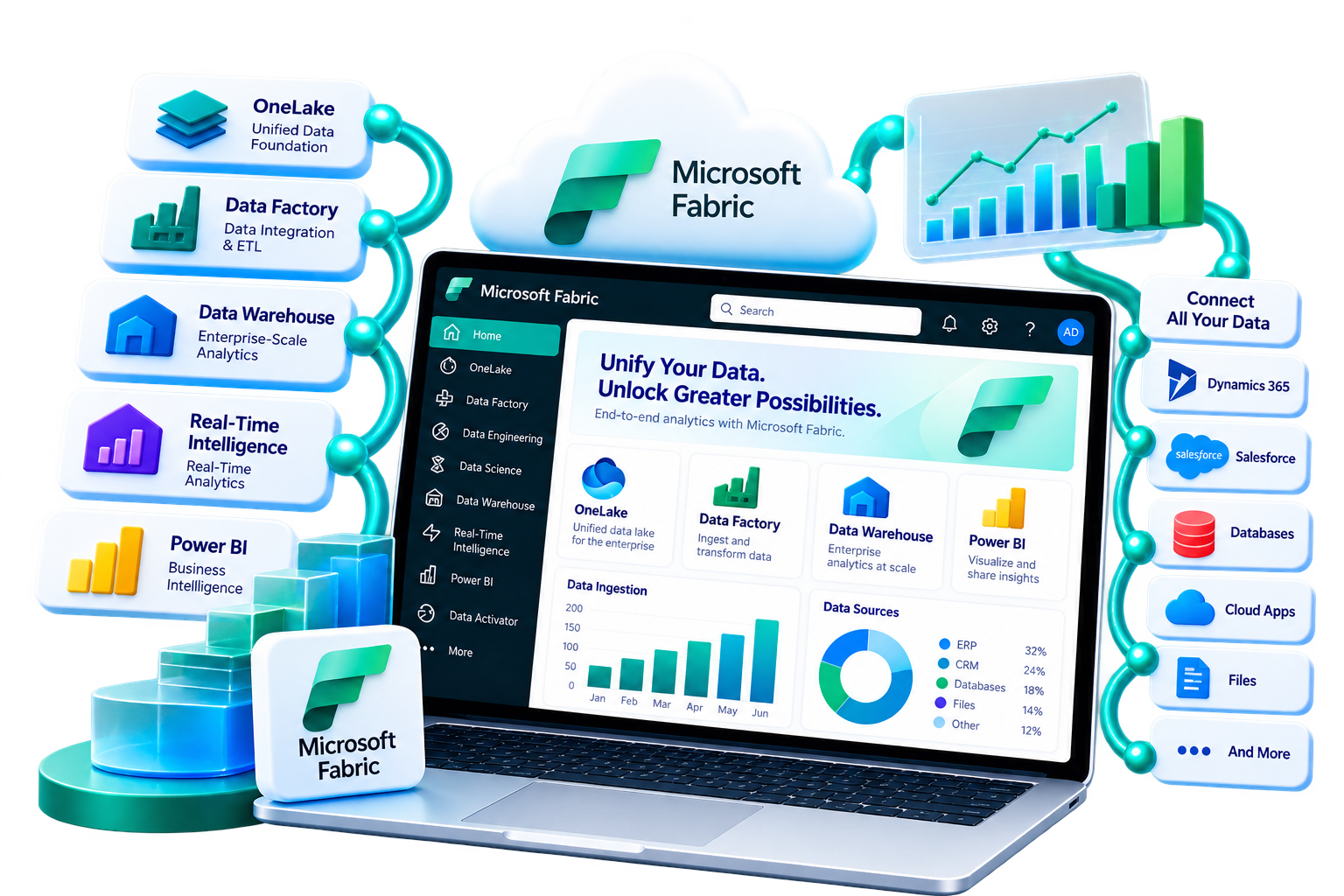

As organizations grow, data becomes distributed across ERP systems, CRM platforms, databases, spreadsheets, cloud applications, data warehouses, data lakes, and legacy platforms.
This fragmentation can make it difficult to establish trusted data, maintain scalable pipelines, support analytics, and provide consistent business intelligence.
Sarakadiya helps organizations modernize their data environment with Microsoft Fabric, designing architectures that connect data integration, OneLake storage, data engineering, analytics, Power BI semantic models, governance, and advanced workloads.
Microsoft Fabric brings together multiple data and analytics workloads around a common platform and OneLake data foundation.
Sarakadiya helps organizations determine which Fabric workloads and architecture patterns are appropriate for their requirements rather than implementing Fabric as a one-size-fits-all solution.
Establish a modern data architecture using the Microsoft Fabric workloads appropriate for your business.
Assess existing data warehouses, data lakes, ETL processes, BI platforms, and cloud data environments and identify opportunities for Fabric modernization.
Connect ERP and CRM data with Microsoft Fabric and Power BI to establish a broader enterprise analytics environment.
Modernize fragmented reporting, legacy data warehouses, ETL processes, and disconnected analytics environments.
Establish the data foundation required for Data Science, machine learning, advanced analytics, and supported AI scenarios.
Microsoft Fabric provides an integrated environment for data integration, data engineering, data science, real-time analytics, data warehousing, and business intelligence. OneLake provides the common logical data lake underpinning Fabric workloads.
Sarakadiya helps organizations design architectures across the Fabric workloads that align with their data, analytics, engineering, governance, and business requirements.

Define a Fabric roadmap aligned with your business objectives, data landscape, analytics requirements, and technology strategy.

Implement the Fabric architecture and workloads required for your organization’s data and analytics environment.

Design a unified data foundation around OneLake and appropriate data-access patterns.
OneLake is the unified logical data lake underpinning Fabric workloads, and Microsoft documents shortcuts as a way to reference supported data locations without necessarily copying the underlying data.

Connect enterprise data sources and build scalable data movement, transformation, and orchestration processes.
Fabric Data Factory supports data ingestion, transformation, and orchestration across a broad range of data sources and integration scenarios.

Design Lakehouse architectures for data engineering, analytics, and data science.

Design structured analytical environments for SQL-based enterprise reporting and analytics.

Build scalable data engineering architectures for ingestion, transformation, processing, and analytics-ready data.

Build data science environments around your enterprise data foundation.

Design architectures for streaming data, event-driven analytics, and operational intelligence.
Fabric Real-Time Intelligence includes capabilities such as Eventstream, Eventhouse, Real-Time hub, and KQL-based analytics for event-driven and streaming scenarios.

Connect Fabric data architecture with Power BI semantic models and enterprise analytics.
Direct Lake is a Power BI semantic-model storage mode available in Fabric and is designed for Fabric data stored as Delta tables in OneLake. It is one architecture option alongside Import and DirectQuery.

Modernize legacy data warehouses, data lakes, ETL processes, BI platforms, and fragmented analytics environments.

Establish governance and security practices for a scalable Fabric environment.

Improve performance, reliability, architecture, and maintainability across your Fabric environment.

Prepare your data and analytics architecture for advanced analytics and supported AI scenarios.
Sarakadiya helps organizations assess their data landscape, design the right Fabric architecture, implement the required workloads, integrate business systems, and establish governance for long-term scalability.
Microsoft Fabric provides a broad set of data and analytics capabilities, but successful implementation depends on choosing the right architecture, workloads, data models, and governance approach.
A Fabric implementation requires more than moving data.
It requires decisions around OneLake, Data Factory, Lakehouse, Warehouse, Data Engineering, Data Science, Real-Time Intelligence, Power BI semantic models, security, governance, integration, performance, and modernization.
At Sarakadiya, we combine Microsoft Fabric expertise with Dynamics 365, Business Central, Power BI, Power Platform, ERP, data, and business-process knowledge.
Our objective is to build a Microsoft Fabric environment that supports your current analytics requirements while providing a scalable foundation for future data and AI initiatives.
We begin with business objectives, data requirements, analytics use cases, users, and existing systems.
From Fabric assessment and architecture to implementation, integration, modernization, optimization, governance, and support.
Design data architectures using OneLake, Lakehouse, shortcuts, and appropriate data-access patterns.
Build ingestion, transformation, orchestration, ETL, ELT, and integration processes across business and technology environments.
Develop scalable data pipelines, transformations, Lakehouse architectures, and analytics-ready data structures.
Connect Fabric data architectures with Power BI semantic models and enterprise reporting.
Build data foundations that support data exploration, machine learning, predictive analytics, and advanced analytical workloads.
Design streaming and event-driven architectures where real-time analytics and operational intelligence are required.
Assess legacy data warehouses, data lakes, ETL processes, BI platforms, and analytics architectures and define a structured Microsoft Fabric modernization roadmap.
Establish appropriate data, workspace, access, security, and governance practices.
Support ongoing optimization, workload expansion, governance, data architecture improvements, and analytics modernization.
Whether you’re starting your Fabric journey, modernizing an existing data platform, connecting Business Central and Dynamics 365, implementing OneLake, expanding Power BI, or building advanced analytics capabilities, Sarakadiya can help.
Define a Fabric roadmap aligned with your business objectives, data landscape, analytics requirements, and technology strategy.

Implement the Fabric architecture and workloads required for your organization’s data and analytics environment.
Design a unified data foundation around OneLake and appropriate data-access patterns.
OneLake is the unified logical data lake underpinning Fabric workloads, and Microsoft documents shortcuts as a way to reference supported data locations without necessarily copying the underlying data.
Connect enterprise data sources and build scalable data movement, transformation, and orchestration processes.
Fabric Data Factory supports data ingestion, transformation, and orchestration across a broad range of data sources and integration scenarios.
Design Lakehouse architectures for data engineering, analytics, and data science.
Design structured analytical environments for SQL-based enterprise reporting and analytics.
Build scalable data engineering architectures for ingestion, transformation, processing, and analytics-ready data.
Build data science environments around your enterprise data foundation.
Design architectures for streaming data, event-driven analytics, and operational intelligence.
Fabric Real-Time Intelligence includes capabilities such as Eventstream, Eventhouse, Real-Time hub, and KQL-based analytics for event-driven and streaming scenarios.
Connect Fabric data architecture with Power BI semantic models and enterprise analytics.
Direct Lake is a Power BI semantic-model storage mode available in Fabric and is designed for Fabric data stored as Delta tables in OneLake. It is one architecture option alongside Import and DirectQuery.
Modernize legacy data warehouses, data lakes, ETL processes, BI platforms, and fragmented analytics environments.
Establish governance and security practices for a scalable Fabric environment.
Improve performance, reliability, architecture, and maintainability across your Fabric environment.
Prepare your data and analytics architecture for advanced analytics and supported AI scenarios.
Every industry generates different data and requires different analytical models, integration patterns, and business intelligence.
Sarakadiya designs Microsoft Fabric solutions around your industry’s data landscape, operational processes, analytics requirements, and technology environment.

Connect production, inventory, procurement, quality, supply chain, and financial data.

Create a unified data foundation for sales, products, customers, inventory, and operations.

Connect funding, donations, programs, operations, and financial data.

Connect inventory, sales, procurement, suppliers, customers, and warehouse data.

Bring production, procurement, inventory, sales, quality, and financial data together.

Connect property, tenant, occupancy, revenue, and portfolio data.

Connect projects, resources, customers, revenue, costs, and utilization.

Create a unified view of sales, purchasing, inventory, suppliers, and customers.

Connect revenue, customers, products, projects, services, and operational data.

Bring project, procurement, cost, resource, and financial data together.

Connect service, jobs, customers, technicians, inventory, and revenue data.

Build governed analytical environments for operational and financial data.

Connect operational, inventory, procurement, sales, and cost data.
A modern data platform must connect with the systems where business data originates.
Sarakadiya helps organizations design Microsoft Fabric integration architectures across ERP, CRM, databases, cloud platforms, business applications, files, APIs, and external data platforms.
Bring financial, sales, purchasing, inventory, customer, vendor, and operational data into your Fabric analytics architecture.
Connect CRM, customer service, finance, operations, and other Dynamics data sources.
Connect Power Apps, Power Automate, Dataverse, and Power BI with the broader Fabric data architecture.
Use Power BI semantic models and reports to analyze data prepared and stored within Fabric.
Integrate supported Microsoft 365 data sources into enterprise analytics architectures.
Connect SQL Server, Azure SQL, PostgreSQL, and other supported databases.
Integrate supported cloud storage environments using Fabric data integration capabilities and OneLake shortcuts where appropriate.
Connect external data warehouses, lakehouses, and other supported data environments through appropriate integration patterns.
Use connectors, APIs, pipelines, mirroring, shortcuts, and other supported approaches to integrate application data.












Explore how organizations worldwide transformed operations, streamlined finance and accelerated growth with Sarakadiya's Microsoft expertise.
Seamlessly Upgrading an MSP from Business Central 15 On-Premises to Business Central 25 Cloud
Sarakadiya provides Microsoft Fabric consulting, strategy, architecture, implementation, OneLake, Data Factory, Lakehouse, Warehouse, Data Engineering, Data Science, Real-Time Intelligence, Power BI, semantic model, integration, governance, modernization, optimization, and support services.
Microsoft Fabric provides an integrated environment for data integration, data engineering, data science, real-time analytics, data warehousing, and business intelligence.
OneLake is the unified logical data lake for Microsoft Fabric and provides a common data foundation for Fabric analytics and AI workloads.
Fabric Data Factory provides data integration, data movement, transformation, and orchestration capabilities across supported data sources and destinations.
A Fabric Lakehouse is a core Fabric storage experience that uses OneLake and supports structured and unstructured data, Delta tables, data engineering, analytics, and data science workloads.
Fabric Data Warehouse provides a structured analytical environment optimized for SQL-based analytics and works as part of the broader Fabric ecosystem.
A Lakehouse provides flexible storage and processing for structured and unstructured data and is commonly used for data engineering and analytics. A Warehouse is optimized for structured, SQL-based analytical workloads. The right choice depends on your data architecture and workload requirements.
Yes. Business Central data can be incorporated into a Fabric architecture using appropriate Microsoft-supported integration and data-movement approaches. The specific architecture depends on data volume, refresh requirements, security, licensing, and business requirements.
Yes. Fabric can integrate with supported Dynamics 365 data sources and broader Microsoft data architectures.
Power BI provides business intelligence and visualization capabilities within the broader Microsoft Fabric ecosystem. Power BI semantic models can consume Fabric data, including data from Fabric Lakehouse and Warehouse scenarios.
A Power BI semantic model provides the analytical layer that organizes business data, relationships, measures, calculations, and business definitions for reporting and analysis.
Direct Lake is a Power BI semantic-model storage mode available in Microsoft Fabric. It is designed for large Fabric data sources using Delta tables in OneLake and loads required data into memory for interactive analysis. Direct Lake is one option alongside Import and DirectQuery.
Yes. Fabric Data Science supports data preparation, exploration, machine learning, model development, experimentation, training, evaluation, and scoring.
Yes. Fabric Real-Time Intelligence supports event-driven scenarios, streaming data, data ingestion, analytics, visualization, monitoring, and real-time actions.
Microsoft Fabric modernization involves assessing and modernizing existing data warehouses, data lakes, ETL/ELT processes, BI platforms, reporting environments, and data architectures using appropriate Fabric capabilities.
Yes. Sarakadiya can assess your existing data warehouse, data models, ETL processes, reports, dependencies, workloads, and governance requirements and develop a Fabric modernization and migration roadmap.
Yes. We can assess Fabric architecture, OneLake organization, Data Factory pipelines, Lakehouse and Warehouse workloads, semantic models, Power BI performance, governance, and capacity considerations.
Yes. Microsoft Fabric provides governance and security capabilities across the platform. Sarakadiya can help establish appropriate workspace, data, access, security, monitoring, and governance practices based on your architecture.
The timeline depends on the number of data sources, data volumes, existing architecture, workloads, integrations, migration scope, security requirements, Power BI environment, and governance requirements.
Sarakadiya combines Microsoft Fabric, OneLake, Data Factory, Lakehouse, Warehouse, Data Engineering, Data Science, Real-Time Intelligence, Power BI, semantic models, Dynamics 365, Business Central, Power Platform, integration, governance, and modernization expertise. This allows us to approach Fabric as part of your broader business and technology architecture rather than as an isolated analytics platform.
Whether you’re starting your Microsoft Fabric journey, modernizing a legacy data warehouse, connecting Business Central and Dynamics 365, building a OneLake architecture, implementing Data Factory, developing Lakehouse or Warehouse workloads, expanding Power BI semantic models, enabling Data Science or Real-Time Intelligence, or establishing enterprise governance, Sarakadiya can help.
Our Microsoft Fabric experts can assess your current data landscape, architecture, integrations, analytics requirements, governance needs, and long-term objectives to define the right Fabric strategy for your organization.

We’re excited to be part of Directions EMEA 2026 in Paris, connecting with Microsoft Dynamics 365 Business Central partners, technology leaders, and industry experts.