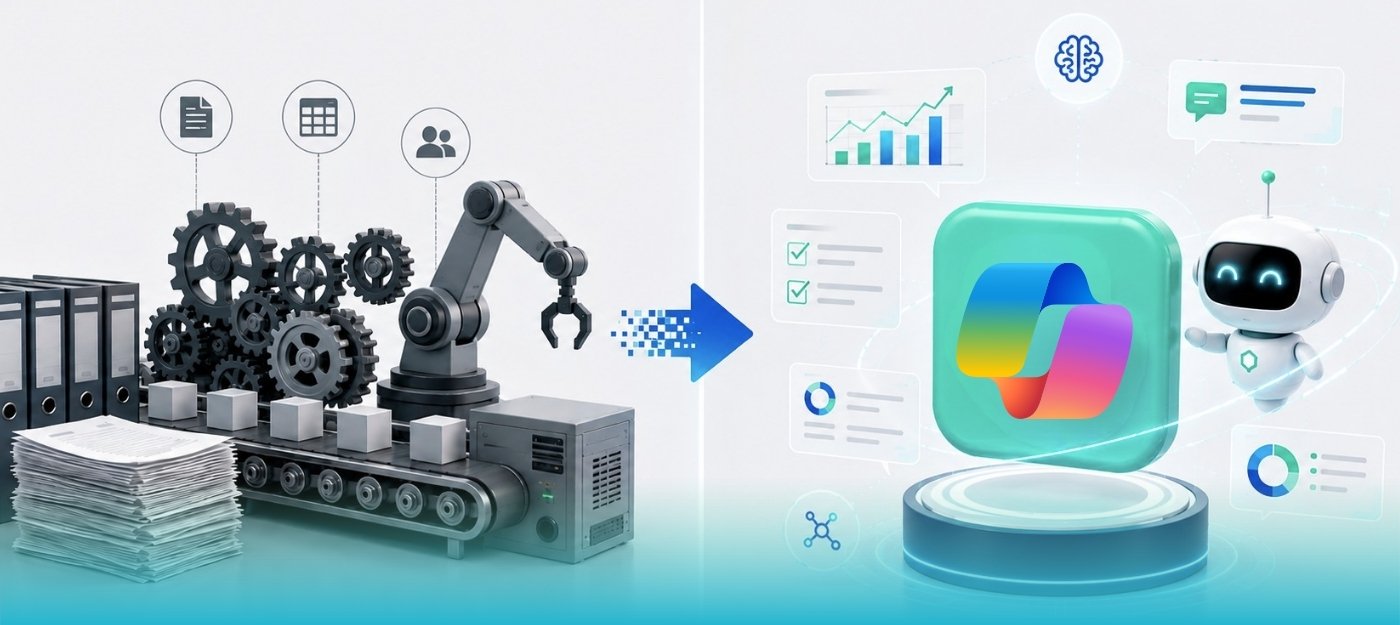





Enterprise resource planning has quietly changed jobs. For decades, ERP systems recorded what had already happened orders placed, invoices paid, inventory counted, and financial transactions completed. Today, a new generation of ERP platforms does something fundamentally different: they help organizations anticipate what’s coming next and recommend the best course of action.
That shift – from a system of record to a system of decision – defines the rise of AI-powered ERP.
Modern platforms such as Microsoft Dynamics 365 Business Central are embedding AI directly into everyday business processes. Instead of relying solely on reports and dashboards, organizations can automate routine work, identify emerging risks, forecast future demand, and receive intelligent recommendations without leaving the ERP.
This guide explains what AI-powered ERP really means, why it’s accelerating now, and how business leaders can prepare for successful adoption.
What Is AI-Powered ERP?
AI-powered ERP is enterprise resource planning software with artificial intelligence embedded into its core business processes-not simply added as a chatbot or external application.
Instead of requiring employees to manually analyze reports and make every operational decision, AI continuously analyzes business data, detects patterns, predicts future outcomes, and recommends the next best action directly within ERP workflows.
In simple terms:
AI-powered ERP helps organizations move from reacting to business events to anticipating them.
For example, instead of discovering inventory shortages after they occur, the ERP can forecast demand, identify potential supply chain disruptions, and recommend replenishment strategies before customer orders are affected.
Why AI-Powered ERP Is Rising Now
Several technology trends have converged to make AI-powered ERP practical for businesses of all sizes.
- Generative AI Has Matured
Generative AI has evolved rapidly over the past few years. Large language models can now summarize financial reports, explain business trends, draft customer communications, and answer operational questions in natural language, making them valuable inside enterprise applications rather than standalone tools.
- Cloud ERP Has Become the Standard
Cloud-based ERP platforms continuously receive AI innovations through regular updates without requiring expensive infrastructure upgrades.
This is one reason why cloud solutions like Microsoft Dynamics 365 Business Central are becoming the preferred foundation for intelligent business operations.
- AI Is Becoming a Core ERP Capability
Artificial intelligence is no longer a premium add-on. Major ERP vendors are embedding AI into finance, supply chain, procurement, sales, customer service, and operations.
Organizations evaluating ERP systems increasingly expect intelligent automation as a standard capability rather than a differentiator.
What Makes AI-Powered ERP Different?
1. Predictive and Prescriptive Analytics
Traditional ERP explains what happened.
AI-powered ERP predicts what is likely to happen next-and recommends what to do.
Examples include:
- Forecasting customer demand
- Predicting cash flow
- Identifying supplier risks
- Detecting declining profit margins
- Recommending inventory replenishment
Example
A manufacturer can receive an early warning that a supplier may miss scheduled deliveries based on historical performance and current purchasing trends. Instead of reacting after production stops, procurement teams can source alternative suppliers in advance.
2. AI Agents That Automate Routine Work
Modern ERP platforms increasingly include AI agents capable of performing repetitive operational tasks.
These agents can assist with:
- Invoice matching
- Bank reconciliation
- General ledger coding
- Approval routing
- Customer follow-ups
- Purchase order processing
Rather than replacing employees, AI handles repetitive work while escalating exceptions that require human judgment.
For finance teams, this means less manual processing and more time spent on strategic analysis.
3. Natural Language Interaction
Users no longer need to build complex reports.
Instead, they can ask questions such as:
- Why did shipping costs increase last month?
- Which customers have overdue invoices?
- What products are likely to go out of stock next week?
The ERP analyzes business data and returns explanations in plain language alongside supporting information.
With Microsoft Copilot in Dynamics 365 Business Central, users can interact with ERP data conversationally, making advanced insights accessible to finance, operations, and sales teams without technical expertise.
4. Real-Time Operational Visibility
Modern ERP increasingly connects with operational systems, IoT devices, warehouse scanners, and production equipment.
Instead of relying on yesterday’s batch uploads, decision-makers gain real-time visibility into inventory, production, logistics, and financial performance.
This enables organizations to respond faster to changing business conditions.
5. Modular AI Adoption
Businesses no longer need to replace their ERP system overnight to begin benefiting from AI.
Many organizations start with focused capabilities such as:
- Demand forecasting
- Financial automation
- Expense management
- Supplier risk monitoring
- Customer service automation
This phased approach reduces implementation risk while delivering measurable business value quickly.
The Business Benefits of AI-Powered ERP
| Business Area | Traditional ERP | AI-Powered ERP |
| Reporting | Historical reports | Real-time insights and alerts |
| Forecasting | Spreadsheet-driven | Continuous AI forecasting |
| Data Entry | Manual | Intelligent automation |
| Decision Making | Reactive | Predictive and proactive |
| User Experience | Static dashboards | Conversational AI |
| Approvals | Manual workflows | AI-assisted recommendations |
| Exception Handling | Human investigation | Automatic anomaly detection |
Organizations adopting AI-powered ERP commonly experience:
- Faster financial close processes
- Reduced manual data entry
- Improved forecasting accuracy
- Earlier identification of supply chain risks
- Better operational visibility
- Higher employee productivity
- Faster business decision-making
5 Signs Your Business Is Ready for AI-Powered ERP
Your organization may be ready to adopt AI if:
- Teams rely heavily on Excel outside the ERP.
- Month-end financial close takes longer than expected.
- Inventory planning is largely reactive.
- Employees spend significant time entering repetitive data.
- Leadership waits days or weeks for business insights.
These challenges often indicate opportunities where AI can deliver measurable operational improvements.
Common Myths About AI-Powered ERP
| Myth | Reality |
| AI replaces finance teams | AI automates repetitive work while people focus on analysis and decision-making. |
| AI guarantees better decisions | AI depends on clean, reliable business data. |
| AI-powered ERP requires replacing everything | Many organizations modernize incrementally by adding AI capabilities over time. |
| AI eliminates governance | Human oversight, approvals, and audit trails remain essential. |
Risks Business Leaders Shouldn’t Ignore
AI-powered ERP is not a plug-and-play upgrade.
Successful adoption depends on strategy, governance, and data quality.
- Poor Data Produces Poor AI
Artificial intelligence learns from business data.
Duplicate customers, inconsistent product information, missing financial records, and inaccurate inventory data can lead to incorrect predictions and recommendations.
Cleaning data should be the first step – not the last.
- Governance Still Matters
Finance and operations teams remain accountable for business decisions.
AI can recommend actions, but organizations still require:
- Approval workflows
- Audit trails
- Compliance controls
- Human review for exceptions
This is particularly important in regulated industries.
- Change Management Is Critical
Technology adoption often succeeds or fails based on people rather than software.
Employees need training, transparency, and confidence in AI recommendations before relying on them in everyday operations.
- Not Every AI Feature Is Truly Intelligent
Some vendors market traditional automation as AI.
When evaluating ERP solutions, ask practical questions such as:
- Does the system predict future outcomes?
- Can it explain recommendations?
- Does it continuously learn from business data?
- Are governance controls built in?
The answers often separate genuine AI capabilities from marketing claims.
How to Prepare for AI-Powered ERP
- Audit Before You Automate
Identify processes where employees regularly export ERP data into spreadsheets.
These are often the highest-value AI opportunities.
- Improve Data Quality
Standardize customer records, vendors, inventory items, and financial data before introducing AI capabilities.
Reliable AI begins with reliable data.
- Start With High-Impact Processes
Many organizations begin with:
- Financial close
- Invoice processing
- Demand forecasting
- Inventory optimization
- Procurement automation
Early success builds confidence and accelerates wider adoption.
- Keep Humans in the Loop
Successful organizations combine AI automation with human expertise.
Rather than fully automating decisions, allow AI to handle routine work while employees review exceptions and make strategic judgments.
- Choose an AI-Ready ERP Platform
Cloud-native ERP platforms are evolving far more rapidly than legacy on-premises systems.
Solutions like Microsoft Dynamics 365 Business Central, enhanced with Microsoft Copilot, provide organizations with continuous AI innovation, enterprise-grade security, and scalable automation without disruptive upgrade cycles.
Frequently Asked Questions
Is AI-powered ERP just a chatbot inside ERP?
No. Chatbots primarily answer questions.
AI-powered ERP predicts future outcomes, identifies anomalies, recommends actions, and automates workflows directly within business processes.
Will AI replace finance and operations teams?
No.
AI is designed to automate repetitive operational tasks while employees focus on strategic planning, compliance, customer relationships, and business decision-making.
Do I need to replace my ERP to use AI?
Not necessarily.
Many organizations gradually introduce AI capabilities through cloud ERP modernization or by extending existing ERP platforms with intelligent features.
What is the biggest challenge when adopting AI-powered ERP?
Data quality.
Organizations with inconsistent or incomplete ERP data often struggle to achieve accurate AI recommendations.
Can small and mid-sized businesses benefit from AI-powered ERP?
Absolutely.
Cloud ERP platforms such as Microsoft Dynamics 365 Business Central make enterprise-grade AI capabilities accessible to small and mid-sized businesses without requiring significant infrastructure investments.
Is cloud ERP necessary for AI?
While some AI capabilities can be added to on-premises systems, cloud ERP platforms make AI adoption significantly easier through continuous feature updates, scalable computing resources, and faster innovation.
The Bottom Line
AI-powered ERP is rapidly becoming the new standard for business operations.
The next generation of ERP platforms will do more than record transactions-they will help organizations predict outcomes, automate routine work, and make faster, data-driven decisions.
For organizations using or evaluating Microsoft Dynamics 365 Business Central, AI capabilities such as Microsoft Copilot are transforming finance, supply chain, inventory management, customer service, and operational workflows through intelligent automation built directly into the ERP experience.
The organizations that achieve the greatest return won’t necessarily be those that adopt AI first. They’ll be the ones that invest in clean data, establish strong governance, empower employees alongside AI, and implement intelligent capabilities where business value is highest.
Ready to Explore AI-Powered ERP?
Whether you’re planning to modernize your ERP, migrate from a legacy Microsoft Dynamics solution, or unlock the full potential of Microsoft Dynamics 365 Business Central with AI and Microsoft Copilot, the right strategy makes all the difference.
Our Microsoft ERP specialists can help you assess your current environment, identify high-impact AI opportunities, and build a practical roadmap for AI-powered transformation that delivers measurable business value.
Contact us today to start your AI-powered ERP journey.